Say what the house is doing on a hot day and we will open the right page.
British summers are changing. Most British homes haven't.
A modern inverter split is quieter than a fridge and cheaper to run than most people imagine. The portable units you've been buying are the problem. Here's the honest cooling guide for UK homes.
Comfort through a warming British summer.
One home, one summer day
Cooling is a day-long sequence, not a single purchase.
Every British cooling question fits somewhere on this arc. Read left to right and each stage explains what the next one has to do; skip the early stages and every later one gets louder, larger and more expensive.
 01 · 12:00
Stage · Gain
Midday heat, nothing intercepted.
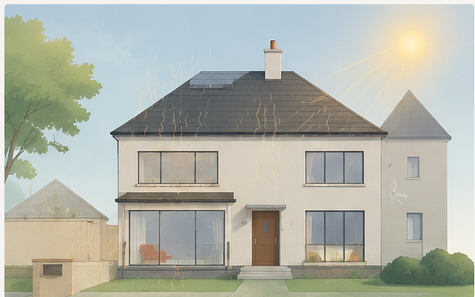
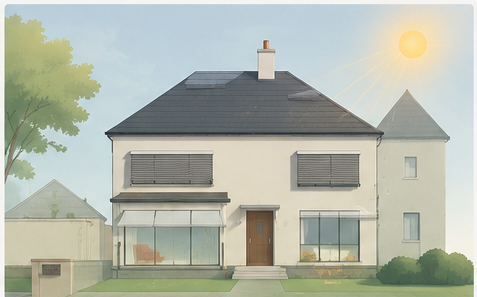
A clear July midday and the sun is delivering roughly the equivalent of a small electric heater into every south-facing room. The house has done nothing to stop it, so the walls, floors and furniture quietly absorb the heat that will make the afternoon uncomfortable.
 02 · 13:30
Stage · Intercept
Shading comes down.
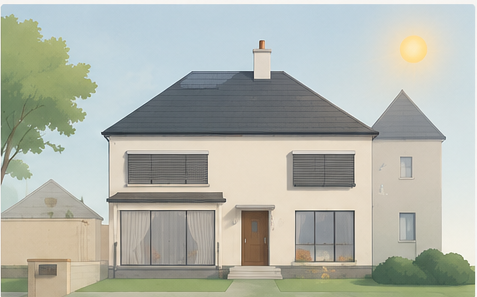
External shutters and an awning drop into place before the peak. Because the shading sits outside the glass, the heat it absorbs is dumped straight back into the outside air rather than into the room; this is where most of the day's overheating is either prevented or created.
 03 · 15:00
Stage · Store
Closed up, riding it out.
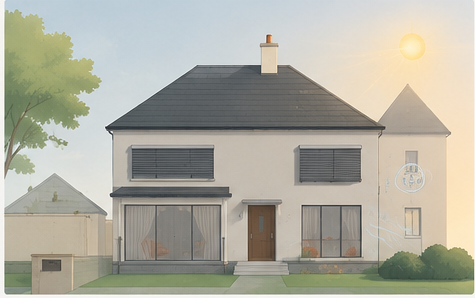
Windows are shut, curtains drawn behind the shutters, doors kept closed against the warmer air outside. The house is now a well-insulated box using its own thermal mass as a battery, holding the morning's cooler air until the sun drops.
 04 · 17:00
Stage · Assist
A small, quiet mechanical assist.
Only after the passive strategies have done their share does the cooling kit run, and only in the rooms that need it. A correctly sized inverter split at this point is doing minutes of gentle work rather than hours of loud sprinting, because most of the heat it would have removed never entered the house.
 05 · 20:30
Stage · Release
The evening turns comfortable on its own.
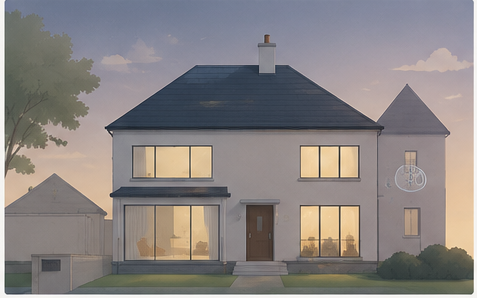
Outside air is now cooler than inside. Shutters open, upstairs windows open on opposite sides, and the house begins to release the stored heat of the day. Warm evenings like this used to be free cooling that most British homes never actually collected.
 06 · 02:00
Stage · Reset
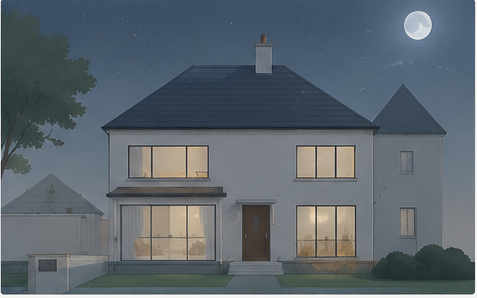
Night purge; tomorrow starts from cool.
A slow cross-draught through the night resets the fabric to the coolest outdoor temperature of the twenty-four hour cycle. Whatever the house holds at dawn is the ceiling from which tomorrow's heat gain begins, which is why the night reset does more for July comfort than any single piece of cooling kit.
- 01 · 12:00
Stage · Gain
Midday heat, nothing intercepted.
A clear July midday and the sun is delivering roughly the equivalent of a small electric heater into every south-facing room. The house has done nothing to stop it, so the walls, floors and furniture quietly absorb the heat that will make the afternoon uncomfortable.
- 02 · 13:30
Stage · Intercept
Shading comes down.
External shutters and an awning drop into place before the peak. Because the shading sits outside the glass, the heat it absorbs is dumped straight back into the outside air rather than into the room; this is where most of the day's overheating is either prevented or created.
- 03 · 15:00
Stage · Store
Closed up, riding it out.
Windows are shut, curtains drawn behind the shutters, doors kept closed against the warmer air outside. The house is now a well-insulated box using its own thermal mass as a battery, holding the morning's cooler air until the sun drops.
- 04 · 17:00
Stage · Assist
A small, quiet mechanical assist.
Only after the passive strategies have done their share does the cooling kit run, and only in the rooms that need it. A correctly sized inverter split at this point is doing minutes of gentle work rather than hours of loud sprinting, because most of the heat it would have removed never entered the house.
- 05 · 20:30
Stage · Release
The evening turns comfortable on its own.
Outside air is now cooler than inside. Shutters open, upstairs windows open on opposite sides, and the house begins to release the stored heat of the day. Warm evenings like this used to be free cooling that most British homes never actually collected.
- 06 · 02:00
Stage · Reset
Night purge; tomorrow starts from cool.
A slow cross-draught through the night resets the fabric to the coolest outdoor temperature of the twenty-four hour cycle. Whatever the house holds at dawn is the ceiling from which tomorrow's heat gain begins, which is why the night reset does more for July comfort than any single piece of cooling kit.
Say what the house is doing on a hot day and we will open the right page.
- 01The bedroom is unbearable on hot nights and you can't sleep.Do I need air conditioning?
- 02You want to cost out an air conditioner before you call an installer.Air conditioning cost
- 03The upstairs rooms cook in the afternoon.Why upstairs overheats
- 04You'd rather not fit AC if a cheaper fix will do.External shading first
- 05You already own a portable AC and it isn't working properly.Portable AC, honestly
- 06You want one score across the whole home before deciding.Home Comfort Score
Most of what makes air conditioning feel noisy or intrusive comes down to bad sizing and worse installation; both are solvable. The right unit, correctly fitted, runs at the volume of a quiet library and costs pennies a day. The wrong one is a thousand-pound mistake.
How cooling works · one home through a summer day
One home through a summer day. Sun climbs, shading drops, cool air moves, dusk resets the room. Small moves at the right time do most of the work; active cooling only handles what's left.
Most of what makes air conditioning feel noisy or intrusive comes down to bad sizing and worse installation; both are solvable.
Comfort through a warming British summer.
Inside this hub
Flagship tool
Air Conditioning Planner
Honest UK install ranges and running cost for the rooms you actually want cooled; not a brochure number.
Read first
Air Conditioning; the UK guide
Inverter splits, multi-split vs single, the kit, the install, the questions that catch installers out.
Compare
Daikin vs Mitsubishi
The two benchmark AC brands, compared on the things that matter.
See it built
Project library
Common UK install patterns; the brief, the kit, the cost band.
Real prices
Cost intelligence
Independent UK price ranges, sourced from industry data; not RRPs.
Where to start.
Air Conditioning
Installed splits and multi-splits for UK homes. What they really cost, what they really sound like, what to spec and what to ignore.
External shading
The single highest-leverage cooling intervention in most British homes. Shutters, awnings, brise soleil and reflective film compared honestly.
Portable AC
Honest about the trade-offs; noise, efficiency, hose placement. When a portable is the right answer, and when it isn't.
Ventilation strategy
Night purge, cross flow, stack effect and MVHR summer bypass. The free half of cooling most homes never actually use.
Loft & roof heat path
How a July roof reaches 70°C and pours heat down into upstairs bedrooms; and the fabric fixes that actually break the path.
Fans & passive cooling
Ceiling fans, night purge, thermal mass. The unglamorous strategies that quietly do most of the work in a UK summer.
Decide with data.
Do I need air conditioning?
Open plannerHome Comfort Score
Open plannerCost Database
Open plannerProject Library
Open plannerWalk your home through the cooling decision engine. Saves a sourced answer to your Home Brief.
Your next step
Take the next step.
Every tool quietly contributes to Your Home so the next recommendation is sharper than the last.
Why it matters