Cooling · External shading
Stop the heat at the glass. Everything downstream gets easier.
Roughly two-thirds of the solar heat that overheats a British bedroom in July comes through the glass. External shading blocks it before it ever enters. Internal blinds cannot; they slow it down slightly and then re-radiate it into the room.
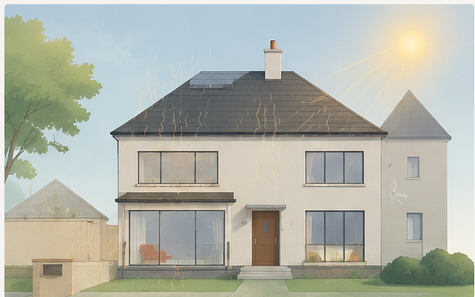
July afternoon, no shading
This is the house before shading. On a heatwave afternoon the south-facing bedroom is climbing while the outside air is already dropping.
Why external always beats internal.
Solar radiation is short-wave; it passes cleanly through glass. Once it lands on anything inside the room, including an internal blind, it is absorbed and re-emitted as long-wave infrared, which the same glass now traps efficiently. The blind has become a small radiator sitting in your window.
External shading interrupts the radiation before it reaches the glass. Whatever heat it absorbs is dumped into the outside air and swept away by wind. CIBSE's design shading factors reflect this asymmetry: external systems typically block 60 to 75 percent of solar gain, internal systems 10 to 25 percent.
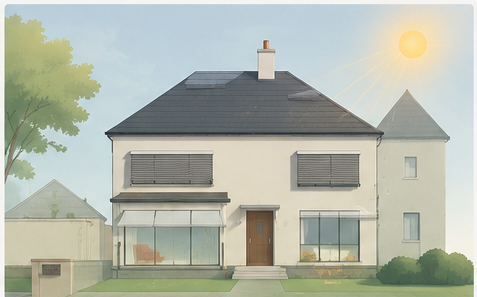
Same afternoon, external shutters fitted
Same house, same afternoon; the shutters have taken most of the gain out of the picture and the bedroom is behaving.
Four options; each fits a different situation.
Pick the one that fits your elevation, your planning constraints, and how much of the decision you want to make once and forget.
External roller shutters
- Strength
- Best-in-class blackout and heat rejection; motorised versions can tie into a thermostat and close on hot afternoons whether anyone is home.
- Trade-off
- Continental in appearance; rarely a fit for listed or conservation frontages.
- Best for
- West-facing bedrooms in a semi or terrace where you own the elevation.
Retractable awnings
- Strength
- Elegant on south-facing living rooms above a patio; disappear when retracted.
- Trade-off
- A wind sensor is not optional; the fabric that saves you in July is a sail in October.
- Best for
- South-facing glazing above ground-floor living space.
Brise soleil
- Strength
- Architectural fixed fins sized to block high summer sun and admit low winter sun; improves the elevation as it improves the comfort.
- Trade-off
- Realistically a build-cost item, not a retrofit weekend job.
- Best for
- New-builds and extensions, or full renovations where the elevation is already being reworked.
How to choose, in order.
Start with the elevation and the room's use. South-facing living rooms tolerate direct sun in the morning; the intervention needs to protect the afternoon. West-facing bedrooms are the priority everywhere; the sun sits low and direct at exactly the wrong hour of the day.
Then consider the fabric. On a solid-wall Victorian bedroom with no cavity insulation, shading buys you the temperature drop that insulation cannot; it is arguably a bigger lever than the loft top-up. On a well-insulated modern build, shading is the finishing move that removes the last few degrees.
Finally, pick between motorised and manual. Motorised pays for itself the first time you are at work during a heatwave and the shutters close by themselves. Manual works fine on holiday homes or windows you pass every morning.
Verdict
External shading, honestly assessed.
If you are about to price up air conditioning for a hot south or west-facing bedroom, price up external shading first; on most UK homes it will halve the cooling load and drop the AC unit down a size band, or remove the need entirely.
A single motorised external roller on the worst window in the house often shifts a bedroom from unliveable to comfortable, at a fifth of the whole-house AC cost. Reflective external film is the option of last resort where nothing external is permitted; still a real intervention, still on the outside of the glass.
The one thing not worth pretending: internal blackout blinds do not solve overheating. They help with glare, sleep and privacy. If the problem is heat, the fix has to sit on the outside of the glass.
What it gives you
- Blocks the heat at its origin; every downstream intervention has less work to do.
- Cuts peak solar gain on a west-facing bedroom by roughly 60 to 70 percent.
- Reversible; you can retract it in October and forget about it.
What it costs you
- External elevation change; check listed / conservation status first.
- Motorised systems add wiring and a wind sensor to the bill.
- Aesthetic commitment on a semi that has never had shutters.
Why we think thisOpenClose
Reasoning
The 60 to 75 percent figure for external systems comes from CIBSE's TM52 and TM59 shading factors, which are the guidance used by mechanical engineers to size cooling loads in UK domestic and educational buildings. Internal-blind factors sit an order of magnitude lower on the same tables because of the re-radiation problem.
Cost bands are our own site-wide 2026 range from installer quotes across five UK regions; single-window roller shutters at £500 to £1,800 depending on motorisation and wind sensing, brise soleil at £350 to £700 per square metre of elevation, reflective external film at £40 to £80 per square metre.
Assumptions
- The window is unshaded by mature planting; add-on planting can carry much of this load in the right situation.
- Peak-load week assumes a typical UK heatwave, not the extreme 2022 event.
- Cost bands assume standard sash or casement windows and one storey of scaffold; genuinely difficult installs sit outside these ranges.
Sources
If this were our house
If this were our house, external shading would be the first cooling money we spent, before we even priced up a portable.
- 1Fit a motorised external roller on the worst west-facing bedroom window; wire it to a thermostat so it closes when the room reaches 24°C.
- 2Add a retractable awning with a wind sensor above the south-facing living room glazing; specified with a cassette housing so it survives winter untouched.
- 3Live with the house through one full summer and only then decide whether any active cooling is still worth commissioning.
This order rests on the current HouseState above; correct anything on Your Home and the priorities update, but the physics that puts external shading first does not change.
A few things people ask before committing.
How much cooling do I really get from external shading?
Won't external shading make the room dark?
Do I still need AC after shading?
What about internal blinds and curtains?
External shading is the first cooling money most UK homes should spend, ahead of any active system. It halves the peak solar gain on the worst window, and whatever intervention follows it is either much smaller or unnecessary.